Passive filters.
Measurable gains.
The patented High-Energy Radiation Drain (HERD): a filter technology that removes Cooper-pair-breaking radiation from cryostat wiring, leaving microwave signals untouched.
How HERD works
HERD directs high-frequency radiation away from the main propagating path of the filter and into an absorptive region. Low-frequency radiation never enters that region and propagates undisturbed across the filter.
Cooper-pair breaking radiation
Cooper-pair breaking takes place when the frequency of the incident radiation exceeds 2Δ/h, where Δ is the superconducting energy gap. In aluminium, the most common material used to realize Josephson junctions, the threshold is around 80 GHz. Rejecting radiation above it is a requirement common to all types of lines connected to the QPU.
Absorptive filters and their drawbacks
A common approach is to fill coaxial lines with an attenuating dielectric such as Eccosorb, or copper-powder-filled epoxy. These are highly attenuating at high frequencies, but they also attenuate in band, and the attenuation increases with frequency, which distorts fast pulses. On charge lines the in-band loss also increases the active load on the coldest stage, which in turn limits the number of qubits that can be controlled with a finite cooling power. Because the fill is a mixture of absorptive particles and epoxy, performance varies from unit to unit, and magnetically loaded epoxies are sensitive to high magnetic fields.
The leaky coaxial waveguide
The coaxial line is surrounded by hollow waveguide sections that open onto it. A hollow waveguide carries no propagating mode below its cutoff frequency, so signals in the passband pass the openings undisturbed. Above cutoff, radiation couples into the waveguides and is absorbed at their terminations, outside the signal path.
Stopband extent
Thanks to its arrangement, the filter presents no parasitic leakage paths, so that, unlike conventional resonant filters, the stopband extends to very high frequencies. Because the absorptive material is separated from the main waveguiding path, variations in its properties do not affect in-band performance, and no magnetic materials are used.
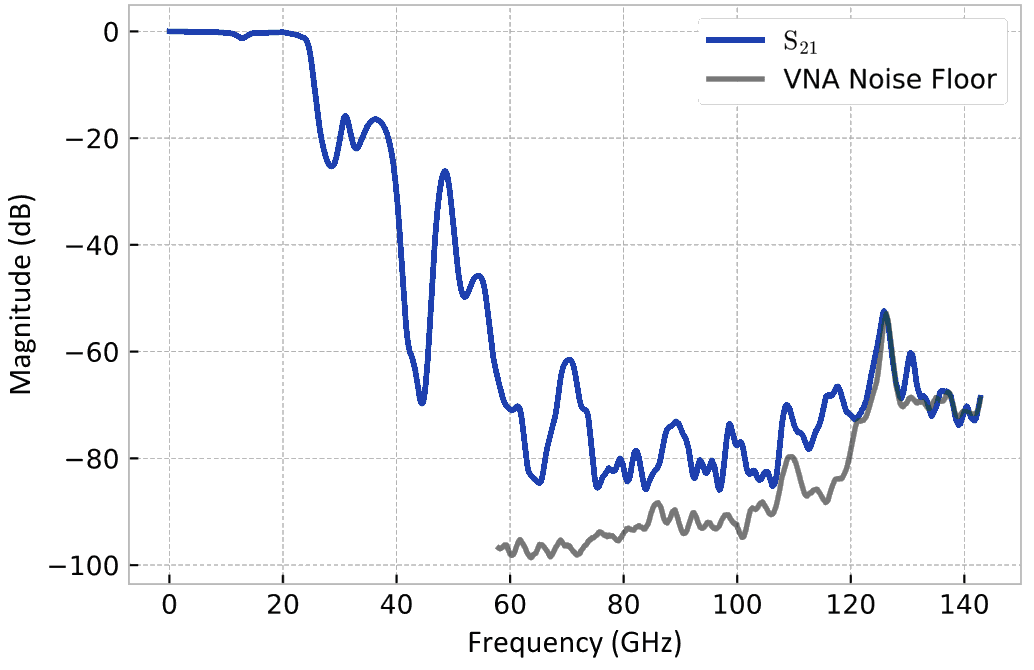
Flat in-band response with broadband absorption above 65 GHz. Insertion loss below 0.15 dB typical from DC to 8 GHz; attenuation in excess of 60 dB above 70 GHz. VNA noise floor shown for reference.
The science behind HERD
The peer-reviewed papers and the integration guide for deploying HERD.
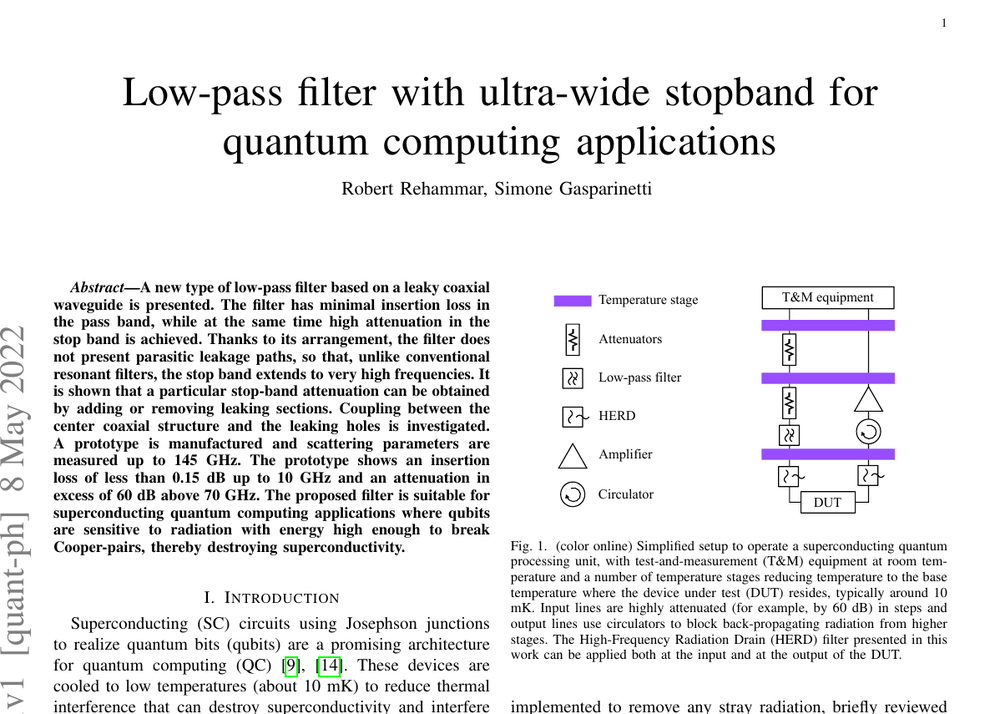
Peer-reviewed paper · IEEE Trans. Microw. Theory Techn. 2023 · arXiv:2205.03941
Low-pass filter with ultra-wide stopband for quantum computing applications
The original HERD paper: the leaky-waveguide filter, with scattering parameters measured from DC to 145 GHz.
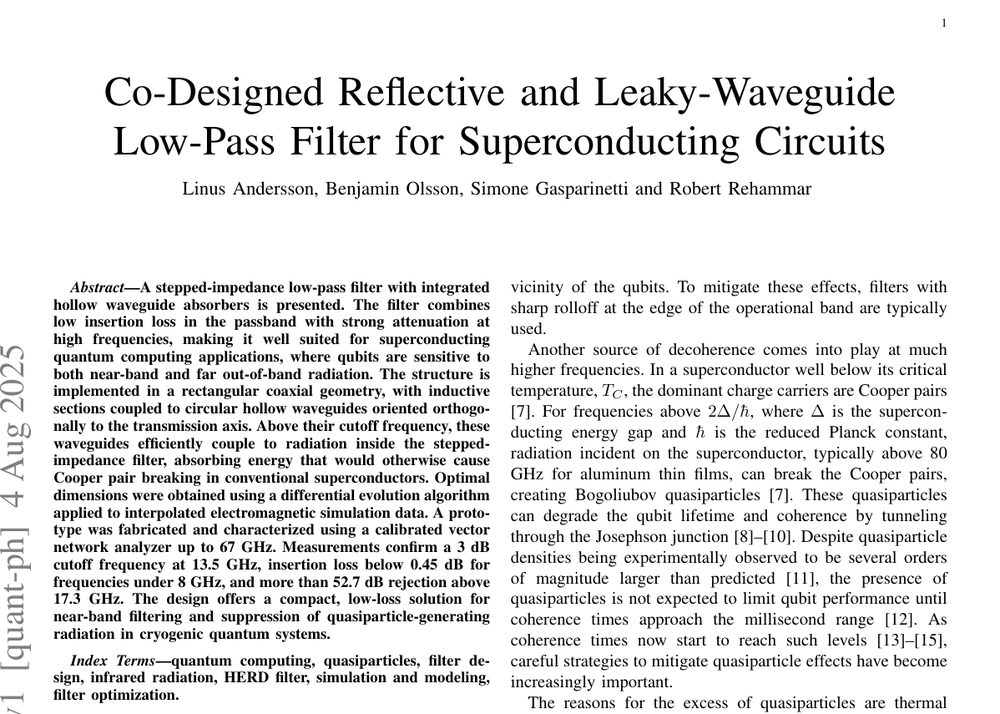
Peer-reviewed paper · 2025 · arXiv:2508.02475
Co-designed reflective and leaky-waveguide low-pass filter for superconducting circuits
A stepped-impedance low-pass filter with integrated hollow waveguide absorbers, from the same group.

Application note
HERD Family Application Note
Which lines to filter, where to install HERD, how to thermalize it, and what published setups have measured.
HERD filters are used in published work from Yale, Princeton, PTB, EPFL, and Chalmers.
All publications using HERDRequest a quote
Contact us for pricing, lead times, and configurations for HERD filters.
Or email sales@swedenquantum.com